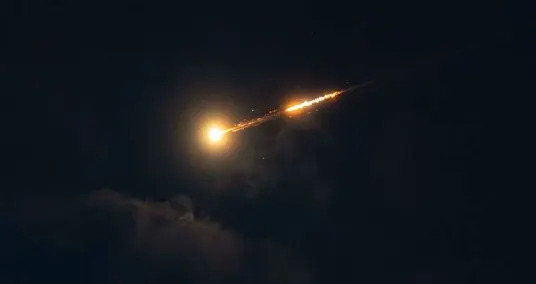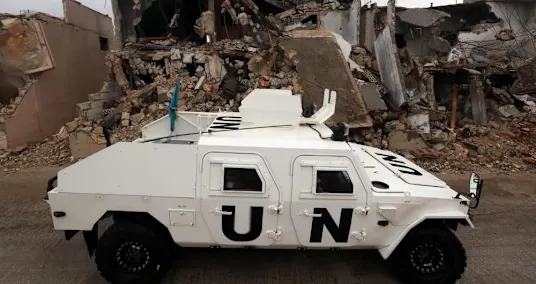
Two Indonesian peacekeepers were killed in southern Lebanon on Monday when an "explosion of unknown origin destroyed their vehicle", the UN agency tasked with policing the region has said.
A third peacekeeper was "severely" injured in the explosion, and a fourth was hurt, the United Nations Interim Force in Lebanon (Unifil) said in a statement.
It is the second fatal incident in the last 24 hours, Unifil noted. A peacekeeper - who was also Indonesian - was killed on Sunday night when a projectile, also of unknown origin, exploded in Adchit Al Qusayr in southern Lebanon.
Unifil said it had launched investigations to determine what happened in both incidents.
The deaths come shortly after the Israeli military announced it would step up ground and air attacks against the Lebanese armed group Hezbollah.
Hezbollah, an Iranian-backed militia as well as a political party, has fired rockets into Israel in retaliation for the ongoing US-Israeli strikes on Iran.
Unifil said of the two deaths on Monday: "We extend our sincerest condolences to the family, friends, and colleagues of those brave peacekeepers who gave their lives in service of peace."
It said under international law, "all actors" had an obligation to ensure the "safety and security" on UN personnel.
"Deliberate attacks" on peacekeepers were "grave violations" of international humanitarian law, Unifil said.
"The human cost of this conflict is far too high. The violence, as we have said before, must end."
Unifil was created by the UN Security Council in 1978, and has since served as a buffer between Israel and Lebanon.
The peacekeeping force patrols the "Blue Line" - the de facto border between Lebanon and Israel, in collaboration with the Lebanese army.
Around 339 peacekeepers have been killed since the mission was established.
Despite a November 2024 ceasefire between Israel and Hezbollah, brokered after violence flared between the two over the war in Gaza, Israel has conducted near-daily strikes on Hezbollah targets.
It says the armed group has not abided by the terms of the ceasefire - under which Hezbollah was meant to disarm and leave its positions in the south - and has accused Unifil and the Lebanese army of not doing enough to remove its militants from the region.
Israel says its latest operation in southern Lebanon was intended to ensure the security of communities in the north.
Since the ceasefire began, 1,238 people have been killed in Lebanon, according to the Lebanese health ministry, including 124 children.
Earlier this month, four Ghanaian soldiers serving with Unifil were injured when their base was hit.
Ghanaian Foreign Minister Samuel Okudzeto Ablakwa did not say who was responsible when speaking at a Commonwealth meeting on Sunday but said the bombing was "an attack on every principle that the UN Charter exists to defend".
LATEST POSTS
- 1
 German Easter peace marches draw tens of thousands
 - 2Highlight Correlation of Microsoft Surface Book and Surface Genius Workstations for Determination
- 3The pinch at the pump continues on
- 4Study reveals links between global food systems, obesity, and climate change
- 57 Peculiar Ways Of starting Your Imagination: Motivation Has Never Been This Good times




- Early Thanksgiving week forecast: Where Americans can expect cold, rain and snow for the holiday
- What happened to Eleven after the ambiguous 'Stranger Things' series finale? Millie Bobby Brown knows — but 'swore herself to secrecy'
- Figure out How to Augment Your Rooftop Substitution Speculation
- Eleven arrested over mass shooting in South Africa tavern
- Saudi Arabia says it intercepted 7 missiles, debris falls near energy facilities
- RFK Jr. releases new dietary guidelines with emphasis on protein, full-fat dairy
- The Response to Self-improvement: Embracing a Development Outlook
- San Francisco sues 10 companies that make ultraprocessed food
- 5 VIPs That Changed Style