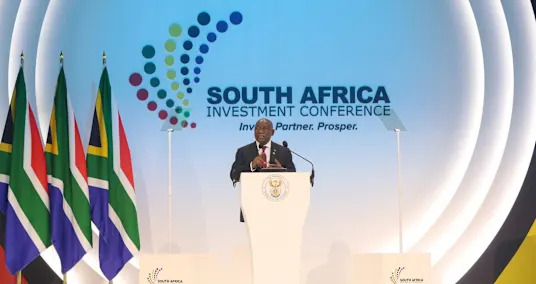
South African President Cyril Ramaphosa launched a nearly $200 billion investment drive aimed at accelerating economic recovery and industrialization in the face of growing worry over the impact of the Iran war on the continent’s biggest economy.
For more than a decade, South Africa’s economy has barely grown, leaving it with crumbling infrastructure and the need to create jobs in a country where one in three people are unemployed. Ramaphosa’s pitch to investors in Johannesburg this week was that South Africa has fixed the worst bottlenecks: He said the country is opening key sectors to private capital and is ready for large scale investments.
Ramaphosa said the effort will run through 2030 with delegates at the South African Investment Conference pledging $53 billion across 31 projects spanning energy, logistics, manufacturing, and digital infrastructure. They include Coca-Cola’s $1 billion expansion plan, and a $3.6 billion commitment from Sasol — the world’s biggest maker of fuel from coal — to upgrade operations.
LATEST POSTS
- 1
 Arctic sea ice hits lowest winter level as heat records are shattered worldwide
 - 2Man threatens attack on German high-speed train, injures several
- 3How did birds survive while dinosaurs went extinct?
- 4Sydney Sweeney is returning in 'The Housemaid's Secret': What to know about 'The Housemaid' sequel
- 5A Manual for Pick High Evaluated Food Conveyance Administrations In Significant Urban communities For 2024



- A single shot of HPV vaccine may be enough to fight cervical cancer, study finds
- Bring tissues and skip the mascara: The movie that's making theater-goers sob uncontrollaby
- The most effective method to Recuperate After a Dental Embed Strategy: A Far reaching Guide
- Poll: Most are satisfied with their health insurance, but a quarter report denials or delays
- Upgrading the Healthy benefit of Your Local Vegetables
- Interstellar comet 3I/ATLAS isn't an alien spacecraft, astronomers confirm. 'In the end, there were no surprises.'
- The year's first meteor shower and supermoon clash in January skies
- Arctic is again the hottest it's been in 125 years, with record-low sea ice, NOAA report says
- Scientists document a death from a meat allergy tied to certain ticks


